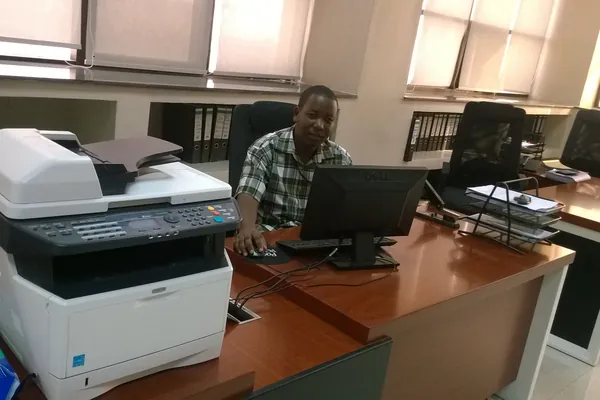
Photo: Thukuk, CC BY-SA 4.0, via Wikimedia Commons
Who these rules cover
The hours of work rules are in Sub-Part B of the Employment and Labour Relations Act. They apply to most employees on Tanzania Mainland. They do not apply to an employee who manages other employees on the employer's behalf and reports directly to a senior manager. Some limits on daily hours, breaks, rest periods and public holidays also do not apply to emergency work that cannot be done during ordinary hours.
If you are a supervisor, check how your contract describes your role. A job title alone does not decide whether you manage other employees.
Ordinary hours: the weekly limits
Under section 19, the most ordinary time an employer may require or permit is:
- six days in any week;
- 45 hours in any week;
- nine hours in any day.
Separately, an employer must not require or permit you to work more than 12 hours in any day, overtime included. A day here means 24 hours counted from the time you normally start work, and a week means seven days counted from the day your working week normally starts.
Overtime: when it is allowed and what it pays
Overtime is work beyond your ordinary hours. An employer may only require or permit overtime under an agreement, and never more than 50 overtime hours in any four-week cycle. An overtime agreement cannot push you past the 12-hour daily limit.
Overtime must be paid at no less than one and a half times your basic wage for each overtime hour.
Suppose your basic wage works out at TZS 2,000 an hour and you work 6 overtime hours in a week.
Overtime rate = TZS 2,000 x 1.5 = TZS 3,000 an hour.
Overtime pay = 6 hours x TZS 3,000 = TZS 18,000.
The hourly figure is invented for the example. The Act includes a table for converting a monthly wage into an hourly rate. Ask your employer which hourly rate it uses, and keep your own record of the hours you work.
Night work: an extra 5% per hour
The Act defines night as the hours after 20:00 and before 06:00. An employer must pay at least 5% of your basic wage for each hour worked at night. If those night hours are also overtime, the 5% is calculated on your overtime rate.
The Act bans night work for some employees: pregnant employees in the two months before the expected birth, mothers for two months after the birth, children under 18, and anyone medically certified as unfit for night work. The medical certificate rules in section 20 can extend or shorten these periods. An employer must transfer a night-shift employee who is certified as unfit for night work, unless that is impracticable.
Breaks and rest periods
If you work continuously for more than five hours, your employer must give you a break of at least 60 minutes. You can be asked to work during the break only if the work cannot be left unattended or done by another employee. The employer does not have to pay for the break unless you are required to work, or to be available for work, during it.
You are also entitled to:
- a daily rest of at least 12 consecutive hours between finishing work and starting again;
- a weekly rest of at least 24 hours between the last ordinary working day of one week and the first of the next.
The daily rest can be cut to 8 hours only in limited cases, such as a written agreement where your working day is interrupted by a break of at least three hours, or where you live at the workplace. A written agreement can also arrange a rest of at least 60 consecutive hours every two weeks.
Working on your rest day or a public holiday
You may work during your weekly rest period only if you agree. If you do, the employer must pay you double your hourly basic wage for each hour worked.
If you work on a public holiday listed under the Public Holidays Ordinance, the employer must pay double your basic wage for each hour worked on that day. Public holidays that fall during your annual leave count as part of the leave, so they do not add extra leave days. Read how leave works.
Compressed weeks and averaging
A written agreement may let you work up to 12 hours a day, including meal breaks, without overtime pay. This is a compressed working week. Even then, the agreement cannot require more than 5 days a week, more than 45 hours a week, or more than 10 hours of overtime a week.
A collective agreement may average ordinary and overtime hours over an agreed period of up to one year. The average cannot exceed 40 ordinary hours and 10 overtime hours a week. Averaging needs a collective agreement with a trade union, not just a line in an individual contract.
Keep your own record
Most hours disputes come down to records. Keep a simple log:
- the date, start time, end time and breaks for each shift;
- which hours were overtime, night hours, rest-day work or public holiday work;
- who asked you to work extra time, and how;
- the amount paid for each on your payslip.
Compare the log with your payslip every month. If something is missing, raise it in writing with your supervisor or the human resources office first. If it is not fixed, a dispute about pay under the Act can be referred to the Commission for Mediation and Arbitration within 60 days of the dispute arising. Read the CMA guide.
Frequently asked questions
How many hours a week is normal in Tanzania?
The Act allows up to 45 ordinary hours a week, over no more than six days, with no more than nine ordinary hours in any day.
What is the overtime rate in Tanzania?
At least one and a half times your basic wage for each overtime hour. Overtime needs an agreement and cannot exceed 50 hours in a four-week cycle or take you past 12 hours in a day.
Do I get extra pay for night shifts?
Yes. For each hour worked between 20:00 and 06:00, the employer must pay at least 5% of your basic wage extra, calculated on the overtime rate if the hours are overtime.
Is public holiday work paid double?
Yes. Section 25 requires double your basic wage for each hour worked on a public holiday.
Sources and checks
Checked . Follow the original source for amendments.